
How to Keep Short, Consistent Notes on Academy Homework and Lessons
When a child comes home from the academy and you ask, “What did you do today?” the answer is often just “I don’t know” or “Nothing much.” Sometimes it is not even clear whether there was homework, and when you ask about what to bring to the next class, that is when they suddenly say, “Oh, right.”
These are the kinds of conversations that happen all the time at home. Especially right after school or academy pickup, if you do not leave even a short note about the class while it is still fresh, the details are already fading by evening. That is usually how you realize why lesson notes matter in the first place.
In that situation, handing someone a thick notebook or a complicated app usually backfires. If note-taking itself feels like a burden, people stop leaving notes at all. The key is to keep it short and consistent.

Photo by Thought Catalog on Unsplash
Why people stop taking notes
There are usually two reasons people fail to keep notes. One is that there is too much structure, and the other is that they do not know when to write.
Date, subject, lesson content, homework, materials, special notes. The more fields you add, the easier it is to stop after a few days. And once you say, “I’ll write it down later,” nothing usually gets written at all.
Start by minimizing the format
Three note items are enough.
- What we did today: a one-line summary
- Homework: write it down if there is any, and write “none” if there is not
- What to bring next time: only if needed
It needs to fit within three lines to be sustainable. Something like “Covered 30% of the lesson, reading homework, bring textbook next week” is enough. If you can look back later and see the flow of that day, it already did its job.
When to take notes: timing creates the habit
The best time is right after academy pickup or before dinner. Your child’s memory is freshest as soon as they get home, and the conversation usually flows more naturally too.
If you pick your child up yourself, it works well to ask a few quick questions in the car and write it down right away. If they take a bus or come home alone, it helps to make “Do you have homework today?” part of the routine the moment they walk in and record the answer on the spot.
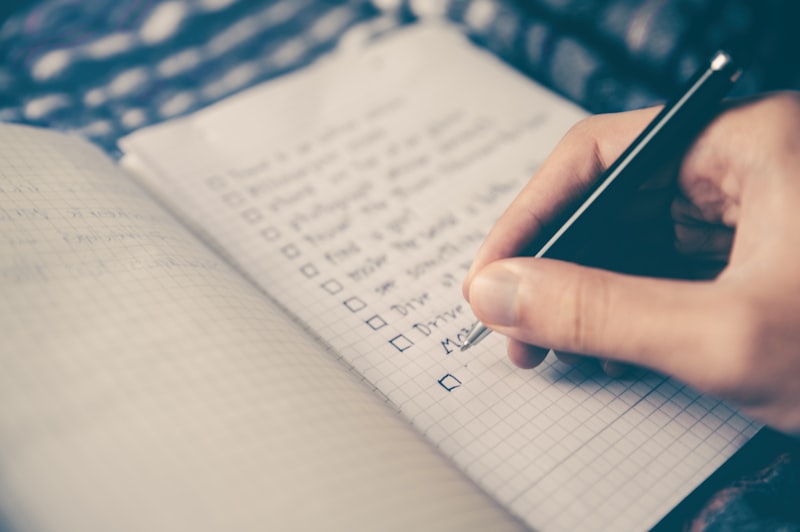
Photo by Glenn Carstens-Peters on Unsplash
When notes build up by subject, you start seeing patterns
If you keep notes separately by subject, they turn into surprisingly useful information over time. In math, you can see which unit took longer than expected. In English, you can see which textbook has been used for months.
It also helps during consultations with teachers. If you can say, “They’ve been working on fractions since April,” with something concrete to support it, the conversation becomes much more specific. Instead of vague anxiety, you get to talk using actual records.
Letting your child record things can also work
If your child is old enough, it can help to let them enter their own homework and materials. They may find it annoying at first, but once they see their own record building up, some kids become interested. A sense of ownership in learning often starts with small habits like this.
What builds a note-taking habit is not adding more fields. It is creating a structure where fewer inputs are enough to prepare for the next lesson. That is why Lesson Manager was designed around a flow where, right after class, you leave a short note about what happened that day and what to look at next, and then check that note again before the next lesson. The records are entered by the user, but once those short notes keep accumulating, it becomes much easier to follow the learning flow again later.
If needed, you can also save photos of textbooks or assignments, but those are only supporting tools. The core is a short text record you can scan again in under ten seconds before the next lesson. From a parent’s perspective, the most practical record is the one that saves you from having the same “What did you do today again?” conversation all over again at night. That view, that a record that lasts is more valuable than a perfect one, was the starting point for the design.